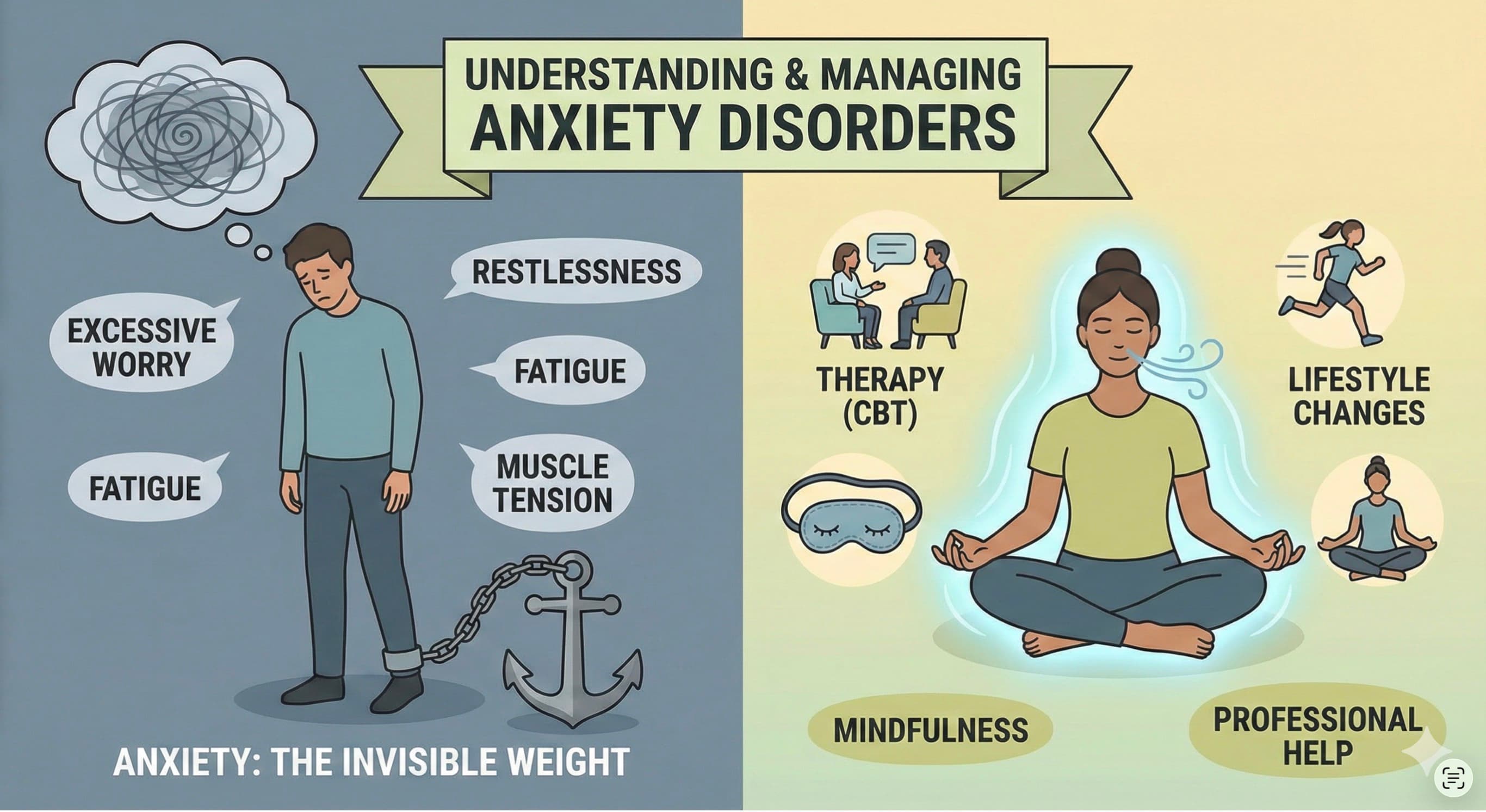
Understanding the Invisible Weight: A Guide to Anxiety Disorders
Is your mind constantly racing, or do you feel physically exhausted from worry? You aren't alone. Anxiety is more than just stress—it is an invisible weight that affects millions. In this guide, we decode the critical difference between everyday nerves and Anxiety Disorders, explore the silent symptoms that often go unnoticed, and share practical, proven strategies—from the '3-3-3 Rule' to professional therapies—to help you silence the noise and reclaim your peace.
We all know that feeling: the flutter in the stomach before a big presentation, the sweaty palms during a first date, or the sleepless night before a major life change. Anxiety is a normal, human reaction to stress. It’s our brain’s way of keeping us alert and safe.
But for millions of people, that "alarm system" gets stuck in the ON position.
When worry becomes a constant companion that interferes with your daily life, happiness, and relationships, it may be more than just stress—it could be an Anxiety Disorder. The good news? It is highly treatable.
Here is what you need to know about the symptoms, types, and how to reclaim your peace of mind.
Is It Stress or an Anxiety Disorder?
The key difference lies in intensity and duration.
Normal Anxiety: Fleeting, related to a specific stressful event, and fades when the event is over.
Anxiety Disorder: Persistent (lasting 6 months or more), excessive (out of proportion to the actual danger), and intrusive (hard to control).
The Signals: Signs and Symptoms
Anxiety isn't just "in your head"—it is a full-body experience. Symptoms are often divided into psychological and physical categories.
1. Emotional & Psychological Symptoms
• Excessive Worry: obsessing over "what if" scenarios (health, money, family) even when things are fine.
• Restlessness: Feeling "keyed up," on edge, or unable to relax.
• Irritability: Snapping at loved ones over small things.
• Brain Fog: Difficulty concentrating or your mind "going blank."
• Dread: A constant feeling that something bad is about to happen.
2. Physical Symptoms
• Fatigue: Feeling exhausted even after sleeping.
• Muscle Tension: Clenched jaw, tight shoulders, or headaches.
• Sleep Issues: Trouble falling asleep or staying asleep.
• Heart Palpitations: Rapid or pounding heartbeat.
• Digestive Issues: Nausea, stomach aches, or IBS-like symptoms.
Common Types of Anxiety Disorders
Anxiety is an umbrella term. It manifests differently for everyone, but these are the most common forms:
Generalized Anxiety Disorder (GAD)
The "chronic worrier." People with GAD feel anxious about a wide range of things—work, health, chores—on most days. The worry is often broad and shifting.
Panic Disorder
Characterized by sudden, intense waves of fear known as Panic Attacks. These can happen without warning and include symptoms like chest pain, shortness of breath, and a fear of dying or losing control.
Social Anxiety Disorder
More than just shyness. This is an intense fear of being judged, embarrassed, or rejected in social situations, leading people to avoid gatherings, public speaking, or even eating in front of others.
Specific Phobias
An intense, irrational fear of a specific object or situation (e.g., heights, spiders, flying, or needles) that leads to extreme avoidance behavior.
Management: How to Find Calm
If you recognize these symptoms in yourself or a loved one, know that you are not broken. You are dealing with a medical condition that has effective solutions.
1. Professional Treatment
• Therapy: Cognitive Behavioral Therapy (CBT) is the gold standard. It teaches you to identify and challenge negative thought patterns.
• Medication: Doctors may prescribe anti-anxiety medications or antidepressants to help balance brain chemistry. Always consult a psychiatrist for this.
2. Lifestyle "Medicine"
Small daily changes can lower your baseline anxiety levels.
• The 3-3-3 Rule: When feeling overwhelmed, look around and name 3 things you see, 3 sounds you hear, and move 3 parts of your body. This grounds you in the present moment.
• Limit Caffeine & Alcohol: Both can mimic or trigger panic symptoms in the body.
• Exercise: Physical activity burns off the excess adrenaline produced by anxiety.
• Sleep Hygiene: A tired brain is an anxious brain. Prioritize 7-9 hours of rest.
3. Mindfulness & Breathwork
Simple deep breathing exercises (like Box Breathing: Inhale 4s, Hold 4s, Exhale 4s, Hold 4s) can physically force your nervous system to switch from "Fight or Flight" to "Rest and Digest."
The Takeaway
Anxiety tells you a lie: that you are unsafe and unable to cope. The truth is, you are resilient.
If anxiety is making your world smaller, reach out. Talk to a friend, contact a mental health professional. Taking that first step is the bravest thing you can do.